-
We Take Care of Us connects you with Certified Nurse Midwives (CNMs) specializing in whole-person, trauma-informed reproductive healthcare care. All CNMs are U.S. licensed providers. The CNMs we help connect you with focus on health promotion, wellness care, gynecologic and family planning services.
-
Telehealth utilizes telecommunications to provide medical care without requiring an in-person visit. During the COVID-19 pandemic, many healthcare providers adapted to telehealth upon discovering how many common health concerns could be effectively treated virtually. Healthcare recipients have also come to appreciate the convenience and safety of accessing care from the comfort of home, as well as the ability to seek out providers based on values-alignment and quality of care rather than geography.
We Take Care of Us and the CNMs we connect you with utilize secure data management and communications technologies to ensure your privacy and safety.
-
The full value of care is $300, but we understand that everyone's situation is different. Our CNMs offer a Community Care Rate and a Pay-it-Forward rate to account for these differences and additional financial assistance for those who can't afford the Community Care Rate.
We ask that each person honestly assess where they fall on the sliding scale based on factors such as income, wealth and relative privilege/marginalization. Our intake forms explain the sliding scale in detail, and you select the price that fits your personal circumstances.
-
Yes. We work with abortion funds to ensure access to medication abortion for those with financial need. You can indicate your need for additional assistance when completing the intake request form.
-
Our CNMs do not accept insurance directly, but can provide documentation if your private insurance offers out-of-network reimbursement.
-
Yes! Your CNM and care team will provide around the clock support via secure messaging.
About our care
About our care
About medication abortion
-
Most people who can become pregnant are eligible. However, there are a small number of medical conditions and situations in which medication abortion is contraindicated. We Take Care of Us will connect you with a provider that will conduct medical screening to confirm eligibility. Contraindications include:
Hemorrhagic disorder or current anticoagulation therapy
Chronic adrenal failure
Current, long-term systemic corticosteroid therapy
Inherited porphyria
Allergy to mifepristone, misoprostol, or other prostaglandin
-
Yes. Medication abortion is extremely safe. For every 100 people, about 99 will have a completely uncomplicated experience. Abortion medications have a better safety record than many common over-the-counter medications, including Tylenol.
-
Yes. Using mifepristone & misoprostol effectively ends pregnancy 98% of the time. Effectiveness can be impacted by dosage timing or if the pregnancy is more advanced than suspected.
-
There are no laws directly criminalizing the ingestion of abortion pills in any state, however there can be legal risk associated with abortion care. To find out more about what is legal in your state and where to go if you are at a later stage in your pregnancy and want an abortion, visit ineedana.com, call the National Abortion Federation hotline, or visit If/When/How.
-
Yes, the US Food and Drug Administration (FDA) approved mifepristone (the first of two medicines used in a medication abortion) in 2000.
about medication abortion
Before medication abortion
-
If you think you are pregnant, typically, a simple urine pregnancy test purchased at the pharmacy or grocery store is an effective, affordable and private way to check. These tests detect the presence of a pregnancy hormone called hCG. If you are pregnant, hCG levels are usually high enough to test positive on a urine pregnancy test from the first day of a missed period.
If you prefer to reestablish your period without confirming pregnancy, that is an option as well. Mifepristone and misoprostol used in this way are referred to as Menstrual Regulation.
-
The duration of pregnancy is measured from the first day of your last period (not from the day you had sex, or think you conceived). To find out how many weeks pregnant you are, enter the first day of your last period into a pregnancy calculator.
-
The two medications used for medical abortion replicate changes that occur naturally just before and during a menstrual period, or during a spontaneous miscarriage. Mifepristone, the first medication, blocks progesterone. Without progesterone, the uterine lining begins to break down and prepares to shed. The cervix of the uterus also prepares to open. Misoprostol, the second pill used in medication abortion, is an analog of the substance that causes cramping during a normal period. It makes the uterus contract, which helps push out the pregnancy tissue.
-
Prepare for medication abortion by organizing your calendar. Make sure you can be free of work, school or family obligations the day you take misoprostol. If possible, plan to take misoprostol in a private and comfortable space, where you'll be undisturbed and have easy access to a bathroom.
Organize your support network. Will someone be present to provide in-person support during your abortion? Will someone be available to drop off extra supplies or a take-out meal? Who can check in with you the next day?
Gather supplies, including: sanitary pads, anti-nausea medication, pain medication, and other comfort measures to manage cramping pain such as a hot water bottle. Prepare a large water bottle or other beverages to keep you hydrated, and light but nourishing foods to eat throughout the process. You can also prepare movies, shows, books and other forms of distraction to help you pass the time.
Before medication abortion
During medication abortion
-
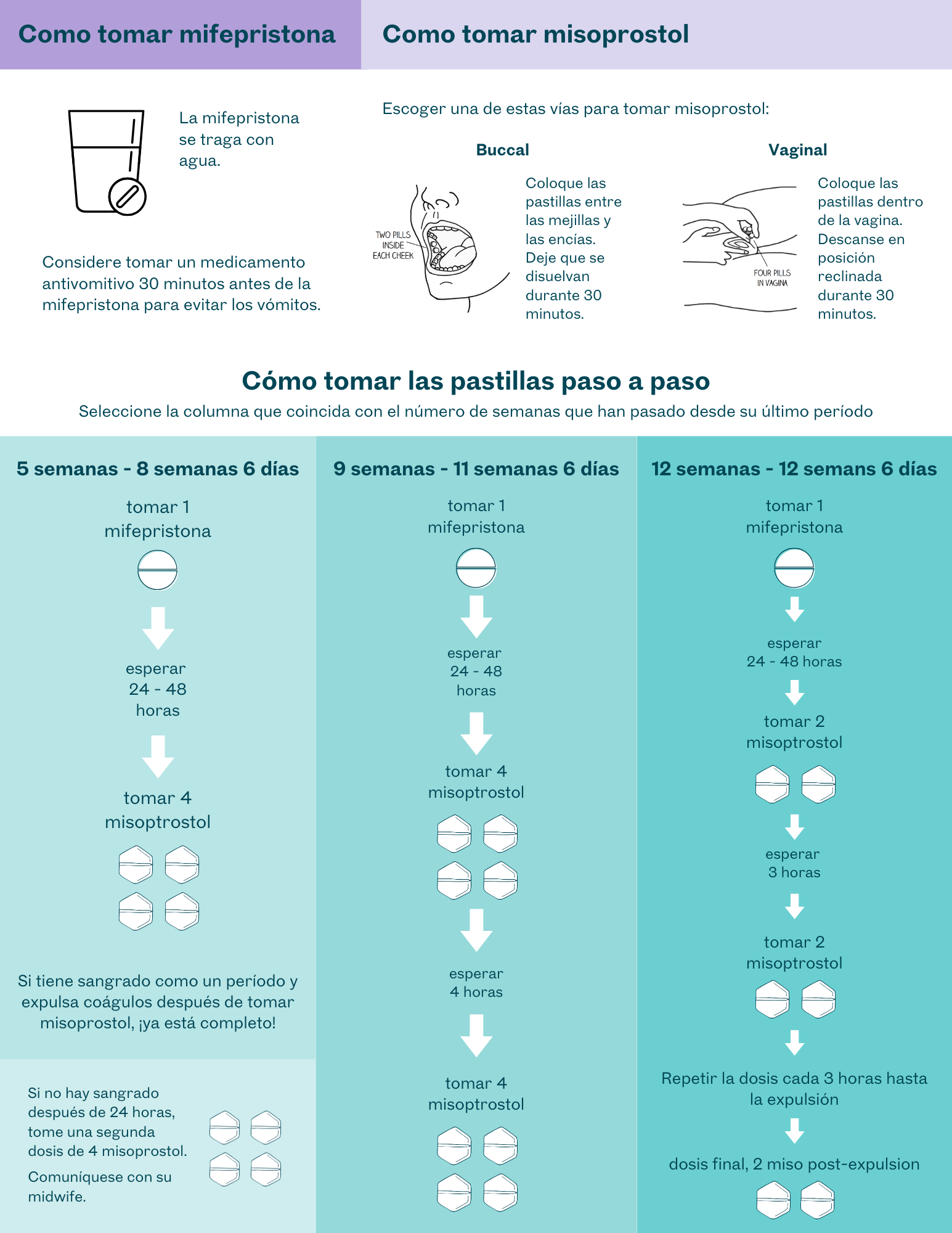
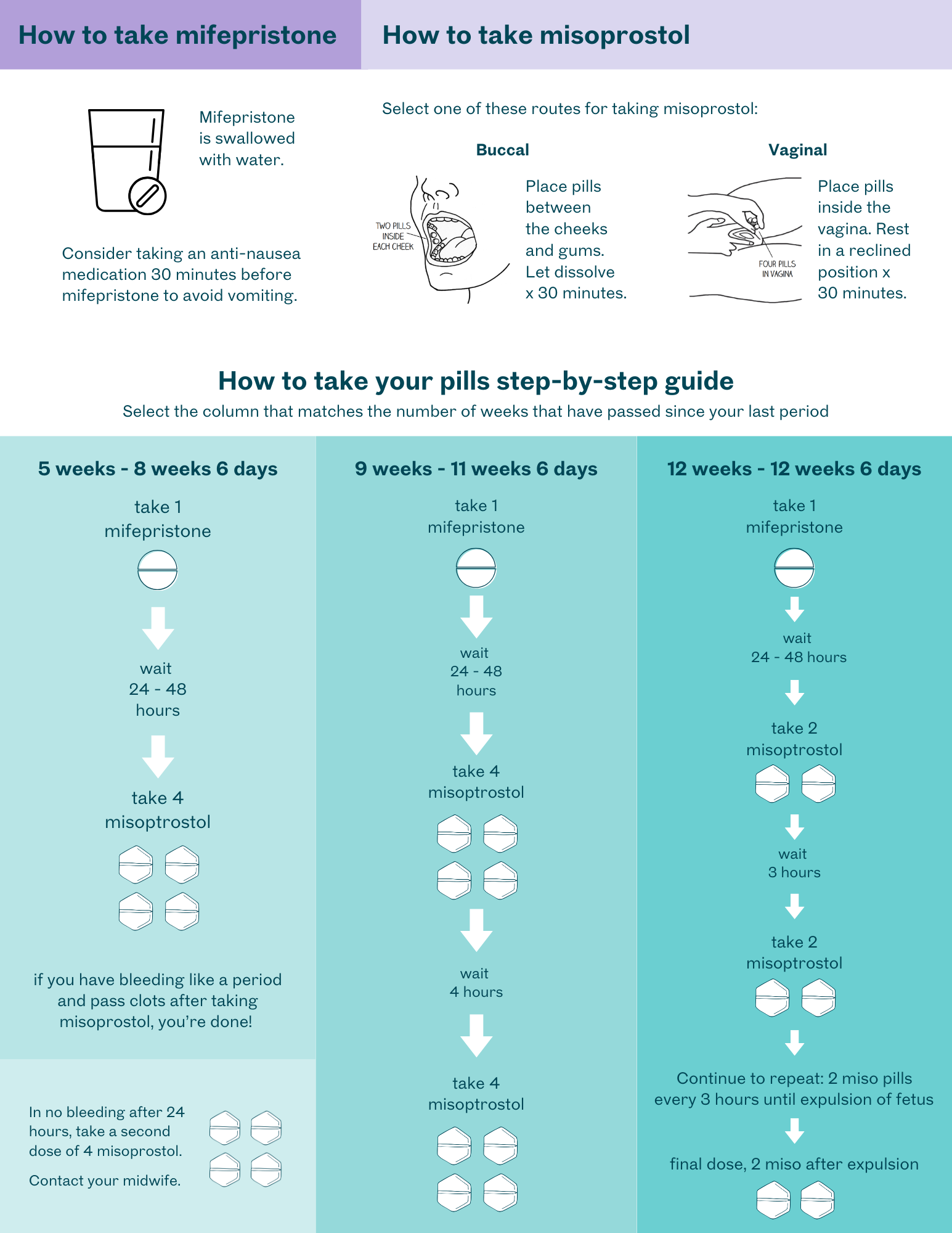
Mifepristone: Taken first by mouth with water.
Misoprostol: Taken 24 to 48 hours later. It is held in the mouth (between cheek and gums) or inserted vaginally for 30 minutes to absorb.
-
Vaginal: Fewest side effects, but residue may remain for a few days (not recommended in restrictive states).
Buccal (Cheek): Management of residue prevents criminalization and has fewer side effects than sublingual.
Sublingual (Under Tongue): Easy to understand but may cause more fever/chills or diarrhea.
-
If you're feeling nauseous, you can grab an over-the-counter medicine like Unisom or Dramamine from your local pharmacy or drugstore. Some other things that can help are ginger tea, chewing gum, or sucking on hard candies. If your nausea is bad, a prescription for stronger anti-nausea medication can also be sent to you if you need it.
-
If you're feeling nauseous, you can grab an over-the-counter medicine like Unisom or Dramamine from your local pharmacy or drugstore. Some other things that can help are ginger tea, chewing gum, or sucking on hard candies. If your nausea is bad, a prescription for stronger anti-nausea medication can also be sent to you if you need it.
-
Mifepristone: Most people have no symptoms, though some experience light bleeding.
Misoprostol: Symptoms usually begin in 1-4 hours. Expect cramping (stronger than a period), nausea, vomiting, diarrhea, and bleeding with clots.
During medication abortion
After medication abortion
-
Bleeding like a period or heavier, and the resolution of pregnancy symptoms (nausea, breast tenderness), are good signs. A home pregnancy test will stay positive for about 4-5 weeks. If you have little or no bleeding, this could be a sign that the pills may not have worked, and you should contact your healthcare provider.
-
Many people return to work or school the day after taking misoprostol. Listen to your body and rest if you feel more tired than usual.
-
You can start most hormonal methods (pills, patch, etc.) the same day or within 7 days of taking misoprostol.
-
Infections are rare (1 in 100). Signs include new/different pain after initial cramping ends, fever more than 24 hours after misoprostol, or foul-smelling discharge.
After medication abortion
How to take abortion pills
How to take abortion medication
Como tomar medicamentos abortivos